How does the punishment for Yunhaiyao’s ByteDance incident compare with previous cases?
SINGAPORE: Food company Yunhaiyao has been fined S$7,000 (US$5,400) over a mass food poisoning incident at tech firm ByteDance’s Singapore office, which left 171 victims sick.
This was the maximum fine the company could have received. But online, some have suggested the penalty was too light, considering the number of people who fell ill.
What happened?
Yunhaiyao, which owns the Yun Nans chain of restaurants, catered lunch for staff of ByteDance at One Raffles Quay on Jul 30, 2024.
After their meals, 171 people suffered gastroenteritis symptoms, including fever, diarrhoea, vomiting, stomachache and headache.
Sixty were taken to the hospital, of whom 22 were warded.
They had eaten a wok-fried diced chicken dish that contained Staphylococcus aureus bacteria, or staph, over 2,000 times above acceptable levels.
Investigations later uncovered a cockroach infestation in a Yun Nans outlet at Northpoint City, which had the catering licence.
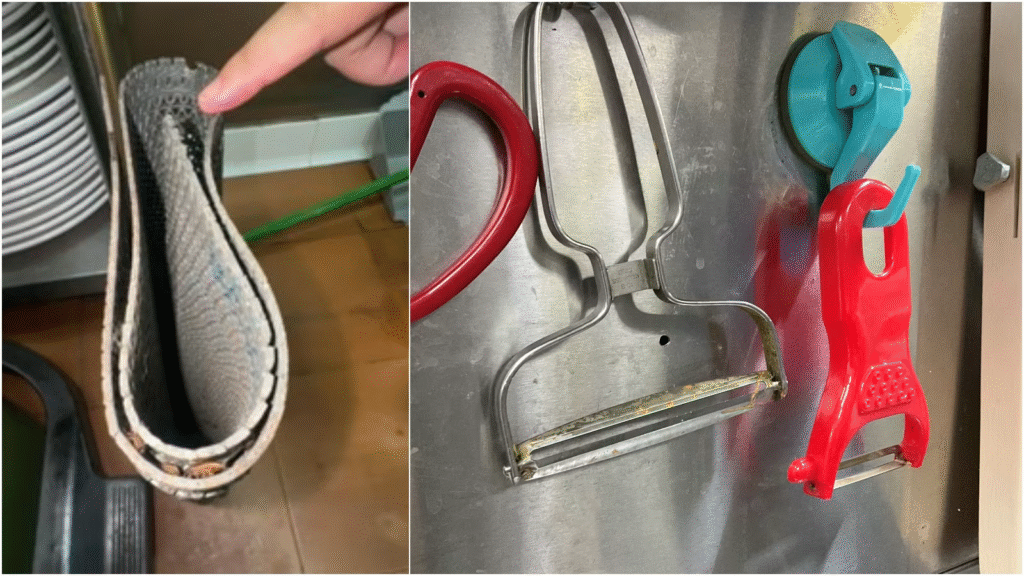
Cockroach infestation (left) and an unclean peeler (right) at Yunhaiyao’s premises located at Northpoint City. (Photos: SFA)
This was the Northpoint City outlet’s first attempt at offering corporate catering. Yunhaiyao said in a statement that there were problems in “basic hygiene protocols” among others.
Yunhaiyao has since closed its Northpoint City outlet and its corporate catering business in Singapore.
Yunhaiyao Pte Ltd was liable for the offence, although it was CEO Lu Zhi Tao who appeared in court to plead guilty and receive the sentence on the company’s behalf.
What’s the punishment for food poisoning?
Yunhaiyao pleaded guilty to two charges.
The first charge was under Section 18 of the Sale of Food Act. This states that a person must not sell food that is not of the quality, nature or substance of food demanded by the purchaser.
For a first-time offender like Yunhaiyao, the maximum punishment is a S$5,000 fine. A repeat offender can be fined up to S$10,000 and jailed for up to three months.
The second charge was under Regulation 26(b) of the Environmental Public Health (Food Hygiene) Regulations.
This states that a person engaged in the sale of food shall ensure the premises are free of rodent, cockroach or other vermin infestation.
The maximum punishment is a S$2,000 fine. If the offence continues after conviction, there is a maximum fine of S$100 for each day it continues.
Yunhaiyao’s fine consisted of the maximum S$5,000 for selling food that was not of the quality demanded by ByteDance, and the maximum S$2,000 for the cockroach infestation.
The judge considered the number of victims to be “staggering” and said it was fortuitous that there were no deaths.
Aside from the actual harm caused to the victims, she also considered the high risk of potential harm caused by Yunhaiyao’s “lackadaisical attitude” towards food safety.
Food poisoning cases can also be dealt with under the Environment Public Health Act.
Section 40 of this Act states that food establishments must not sell any food intended for human consumption that is unsound or unfit for that purpose.
The maximum fine for a first-time offender is S$10,000. A repeat offender can be fined up to S$20,000 and jailed for up to three months.
How does this compare to other food poisoning cases?
In 2014, a four-year-old boy died after eating contaminated food at a food court in Northpoint Shopping Centre.
The stall operator was fined S$1,400 for two breaches – failing to register a food handler and failing to protect food in a covered container.
The stall operator’s licence was also suspended until it had thoroughly cleaned the stall and its food handlers were re-certified in food hygiene.
In another fatal food poisoning case, Spize restaurant in 2018 supplied bento boxes contaminated with Salmonella for a company event. Bacillus cereus and faecal coliforms were also found in a fried rice dish.
Seventy-three people fell ill, of whom 47 were hospitalised. A 38-year-old man who had a Salmonella infection died of sepsis and multi-organ failure following acute gastroenteritis.
Spize was fined the maximum S$10,000 under the Environment Public Health Act, for possessing food unfit for human consumption.
Together with related firm Spize Events, the fines came up to S$32,000. They were convicted of 14 offences, including hiring unregistered food handlers and having poor hygiene practices.
At the time, authorities said there was insufficient evidence linking the fatality to negligence by any particular person, so no individual was charged.
Mr Adrian Wee, managing partner of Lighthouse Law LLC, said the higher number of charges suggested that the conduct in the Spize case was more egregious.
There is also a distinction between incidents that arise from a single breach and from multiple breaches, he said.
For the latter, such as in the Spize case, the cumulative penalties can be significant.
Mr Josephus Tan, managing director of Invictus Law Corporation, said every case was different even if they may look similar on the surface.
Courts also consider factors like the severity of the injuries suffered by the victims, the degree of negligence and the duration of offending, he said.
So was Yunhaiyao’s punishment too light?
“Given the magnitude of the food poisoning in this case, it is not surprising that some may feel that harsher penalties may be warranted,” said Lighthouse’s Mr Wee.
But he noted that financial penalties, and imprisonment for repeat offenders, are not the only means of deterrence.
Offenders also face loss of reputation and the potential loss of their shop or catering licences, he pointed out.
Additionally, the Singapore Food Agency (SFA) can issue directives to ensure food safety standards are met, and did so in Yunhaiyao’s case.
The company was required to throw away food, clean its premises and re-certify all food handlers in food safety. SFA suspended the Yun Nans outlet at Northpoint City until these measures were taken.
Mr Tan from Invictus believes however that the fines were insufficient in this case and food poisoning ones in general, even though the court could not have imposed more than what parliament legislated.
“A commercial operator must always carry a heavier responsibility if they are in the business of profiting from the masses where any subpar, unethical or illegal practices from their end may have tremendous (impact),” he said, citing the food, transport, healthcare, education and renovation sectors as examples.
He pointed to how, under the Workplace Safety and Health Act (WSHA), workplace-related deaths can lead to fines of up to S$200,000 for individuals and and S$500,000 for companies.
“It is timely for parliament to seriously consider amending the relevant legislations governing food safety to mirror those we see in the WSHA,” Mr Tan added.
“It is important to send a message to aspiring commercial operators that if one intends to profit from the masses, one should also be ready to adhere to the strictest industry and legal standards.”
Want an issue or topic explained? Email us at digitalnews@mediacorp.com.sg. Your question might become a story on our site.
Source:CNA


