A British art restorer was shocked when an ordinary painting she was cleaning turned out to be the work of the Italian master Titian. Alastair Sooke tells her story.
Late one Friday afternoon during the spring of 2013, Alice Tate-Harte, a fine-art conservator for English Heritage, found herself alone in the studio working on an unremarkable painting. It was a routine job, cleaning up what she believed was a workaday later copy of a composition by the 16th Century Italian Renaissance master Titian.
The picture, which has been known informally as ‘Titian’s Mistress’ since at least the 18th Century because of its subject, an attractive young woman exposing her left breast to the viewer, was part of the Wellington Collection at Apsley House in London, and it lay flat on the table in front of Tate-Harte, who was inspecting its cracked surface via a microscope.
That afternoon, she recalls, she focused on the painting’s upper right corner. Gently, she started rolling a swab of solvent across it in order to remove a layer of grimy black ‘over-paint’ which an earlier ‘restorer’ had used to cover up the original background, perhaps to bring the picture in line with prevailing tastes at the time.
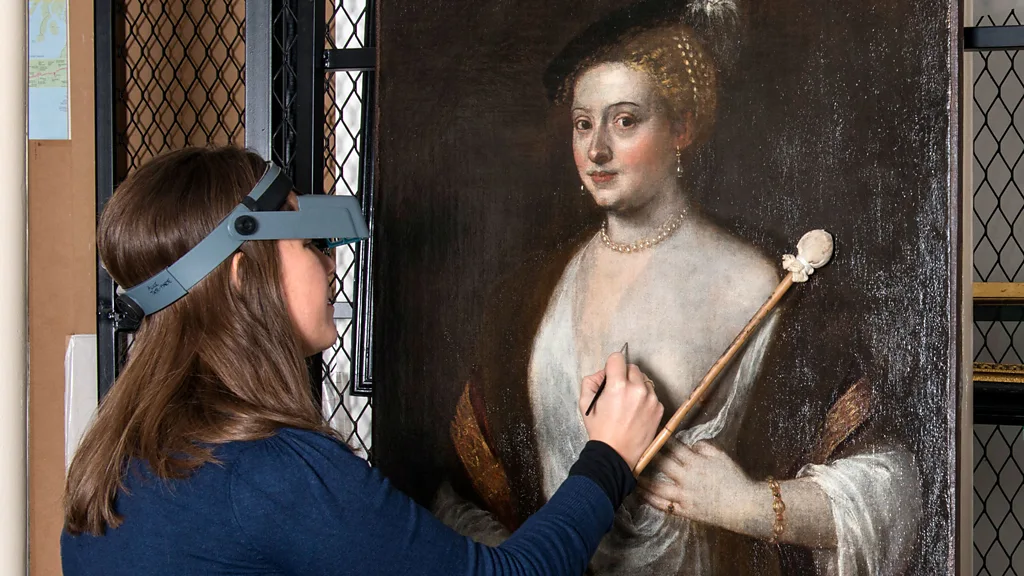
“Suddenly, I saw a yellow brushstroke,” she says. “That looked a bit unusual, so I carried on with even smaller swabs in that area – and slowly the letter ‘A’ started to appear. It was really, really exciting, but there was nobody else in the studio to tell, so immediately I phoned up my husband.”
Tate-Harte had a hunch that the letter belonged to an artist’s signature, and so she carried on working, cautiously uncovering what lay beneath. “Next I found the letter ‘N’ and a ‘V’, and then the remains of an ‘S’ – but then I had to stop because it was about 6.30pm and I had to go home.”
It was an art-historical version of Cinderella
Confident that she could predict how the full signature would eventually appear, she left and returned on Monday morning to finish the job. Once she had, she saw the word ‘TITIANVS’ – a Latinised variant of his name that Titian frequently used as a signature in the latter stages of his career – unambiguously visible through the lens of her microscope. “It’s pretty uncommon as a conservator to be able to work on a Titian, let alone to find a signature,” Tate-Harte says. “So this was a once-in-a-lifetime moment.”
Signature proof
Thanks to Tate-Harte’s discovery, the painting – which for decades had been written off as a weak imitation of Titian, languishing unloved and in terrible condition, torn and dirty, in an easy-to-miss spot in Apsley House – was instantly transformed. Its fate offered an art-historical version of the fairy tale of Cinderella, as an overlooked but alluring girl went from obscurity to the A-list.
Of course, Tate-Harte understood that a signature alone was not definitive proof that the painting was by Titian – after all, someone else could have applied it in order to create the impression that the picture had come from the artist’s workshop, when in fact it hadn’t.
But according to Titian at Apsley House, a new display presenting three recently restored pictures from the Wellington Collection all now attributed to Titian, the signature offers compelling evidence of the painting’s authenticity, when combined with other research.
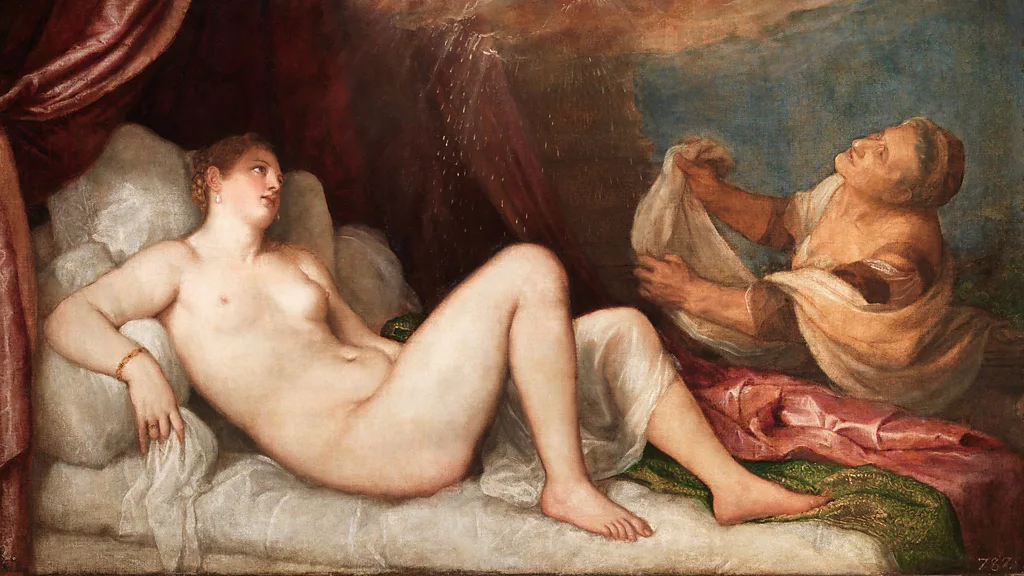
All three pictures, which were once in the Spanish Royal Collection, were looted by Joseph Bonaparte and captured by the victorious Duke of Wellington in the aftermath of the Battle of Vitoria in 1813. The Duke subsequently offered to return them to the Spanish king, but he refused to accept them back. Scholars now believe that another of the paintings, one of six sensuous versions of the mythological story of Zeus seducing Danaë by visiting her in the form of a shower of gold, was the first so-called “poesie” inspired by classical literature sent by Titian to Philip II of Spain.
why, for so long, did experts believe the painting was not the real deal?
The real McCoy
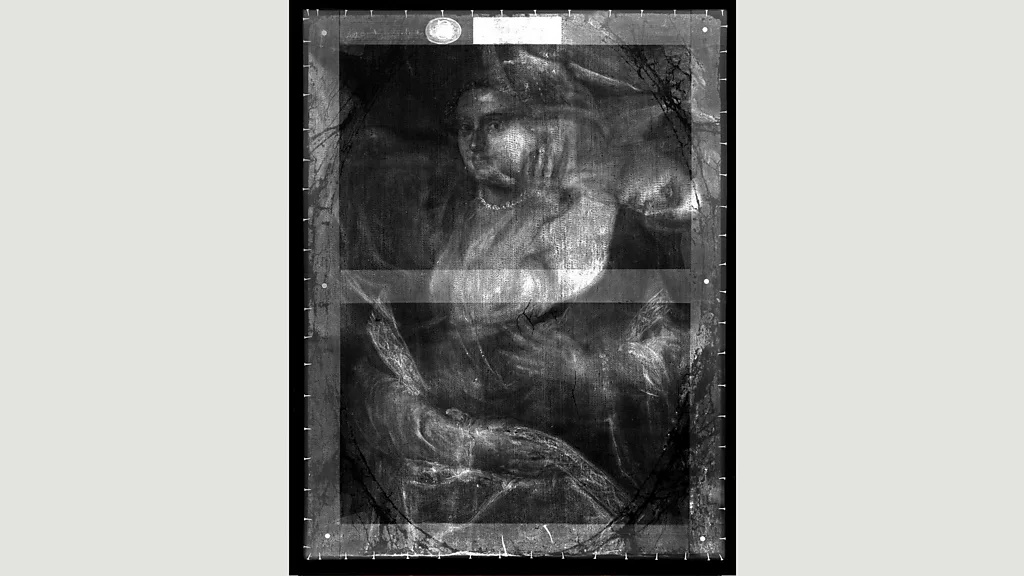
Part of the research into Titian’s Mistress involved having it X-rayed at the Hamilton Kerr Institute in Cambridge. Analysis revealed the ghostly form of another, earlier composition, featuring a semi-clothed woman lifting an arm to pluck her veil. This suggests that, having laid down the foundations for a different subject, the artist abandoned it, turned the canvas clockwise and began a new idea – something art historians believe that Titian often did. Moreover, Tate-Harte says, “All the pigments that I found were consistent with Titian and Titian’s studio and the techniques that he used: using a gesso ground and then building up a brown-and-white sketch before putting the other paint layers on – it was all consistent with Titian.”
Titian’s Mistress, then, is a bona-fide Titian, probably dating from the 1550s. But the discovery poses a question: why, for so long, did experts believe that the painting was by a dull follower of Titian and not the real deal? “The surfaces of Titian’s paintings depend so much on texture, and when they are smothered in dirt and discoloured with varnish, they are very dulled and easy to misjudge,” explains Paul Joannides, an emeritus professor in the history of art from the University of Cambridge who helped to attribute the painting.
“I wouldn’t say that discoveries are very frequent, but they do occur. Titian was prolific and had a very long career – around 70 years – so it is reasonable to expect new works to turn up from time to time, especially relatively minor ones like portraits and single-figure subjects. Titian’s Mistress seems to me a beautiful late painting. Although badly damaged, it shows an extraordinary vitality and energy in the relation of part to part, and an astonishing range of textures – fur, linen, flesh, jewellery, velvet – all conveyed with tactile precision.”
Alastair Sooke is art critic of The Daily Telegraph
If you would like to comment on this story or anything else you have seen on BBC Culture, head over to our Facebook page or message us on Twitter.
Source:BBC


